
The Simple Version: Facebook Counted One Customer Twice — the 4-Day Fix That Led to 8 Booked Tours
The Whole Story in Five Sentences
REVV Travel sells premium guided motorcycle tours. One week, their Facebook and Instagram ads suddenly cost twice as much, and nobody knew why. The ads were fine — the counting was broken: Facebook was counting one real customer as two people. We fixed the counting in four days and let Facebook learn from honest numbers again. Applications became roughly three times cheaper than the worst day, more people booked sales calls, and eight of them have already bought tours.
That is the entire case study. Everything below is the same story, told slowly, with pictures.
If you want the full technical version with every number, it lives here: the original four-day rescue. This page is the version you can send to anyone.
If you want more of the same story:
- The simple version is this page.
- The four-day technical rescue is the original diagnosis.
- The 15-day follow-up is the scaled results and closed tours.
- The sales and lead-quality review is what reached the sales team afterward.
First, One Minute on How Facebook Ads Actually Work
Facebook shows your ad to people it thinks will buy from you.
How does it know who will buy? It watches a counter. Every time someone fills out your form, the counter clicks, and Facebook thinks: "People like this one buy. Find more people like this."
So the entire machine depends on one small thing: the counter must click once per real customer.
If the counter lies, Facebook learns from lies. And robots are excellent at math and terrible at noticing when the math is wrong.
The Problem: A Counter That Counted Twice
Picture a bread shop. The owner wants to count buyers, so he puts a clicker on the door. But the clicker is set up wrong — it clicks for everyone who walks past the window, not just people who buy bread. The owner sees huge numbers, thinks window-shoppers are customers, and starts baking for people who never buy.
That is what happened here, with code instead of a clicker:
- One counter clicked when somebody merely looked at the booking page.
- A second counter clicked when somebody actually submitted the application.
- Facebook added both. One real person = two "customers."
We proved it by putting Facebook's numbers next to the client's own customer list for the same week:
The same week, two counts | Number |
|---|---|
Real people who applied (client's own customer list) | 196 |
What the ad counter reported to Facebook | 443 |
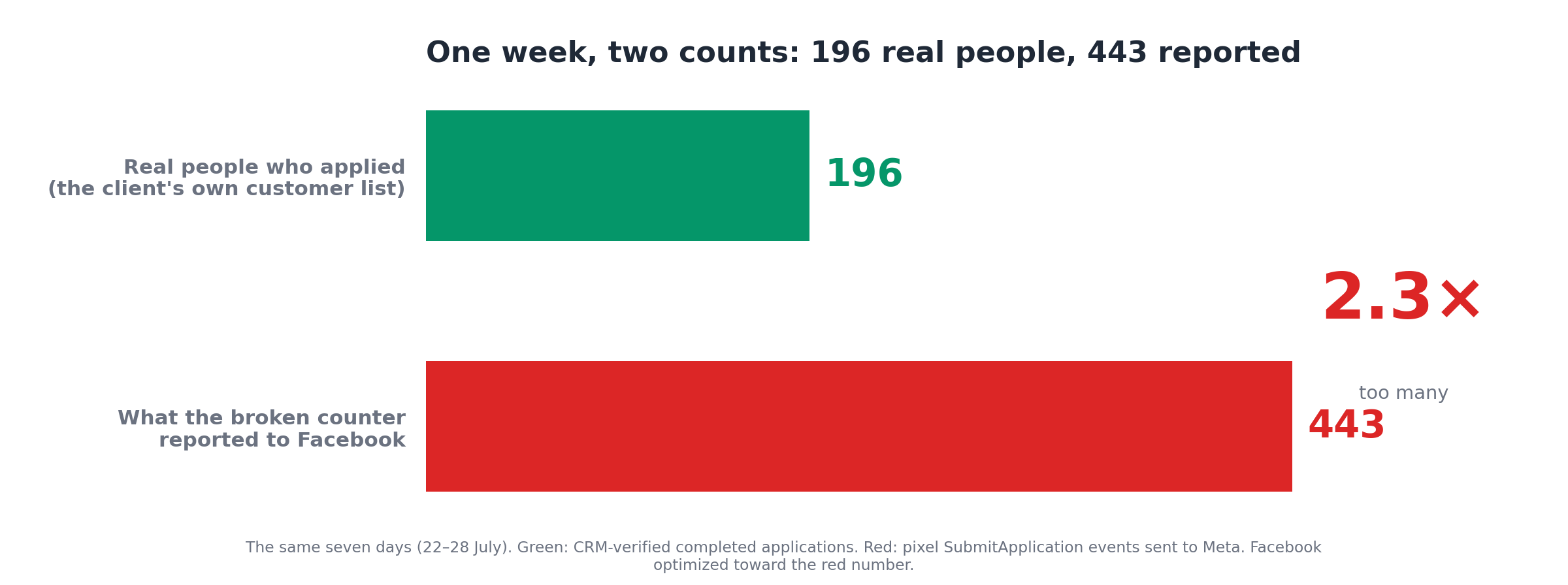
The counter reported 2.3 people for every 1 real person. Facebook spent two weeks looking for more of the fake ones.
Once Facebook was learning from people who did not exist, delivery went strange: one day of almost nothing, then a day at €14 per application. The team's first guess was that their new server tracking broke the account. It had not — the week that tracking went live, costs actually improved. The problem was the extra counter sitting next to it.
The Fix Took Four Days, and It Was Boring
Good fixes usually are. Three steps:
- Delete the broken counter. A "customer" click should never fire when someone just looks at a page. We removed it and kept exactly one honest counter, on the real form submission.
- Stop telling Facebook who to look for. About 70% of the budget was aimed at a hand-built "wealthy people" audience that someone had guessed. We paused it and let Facebook find buyers on its own — which it can do, now that its counter tells the truth.
- Put a price cap on. We told the campaign: never pay more than €6 for one application. When Facebook can't hit that price, it slows down instead of overspending. That is the feature, not a bug.
No new funnel. No extra budget. Just honest counting and fewer guesses.
What Changed
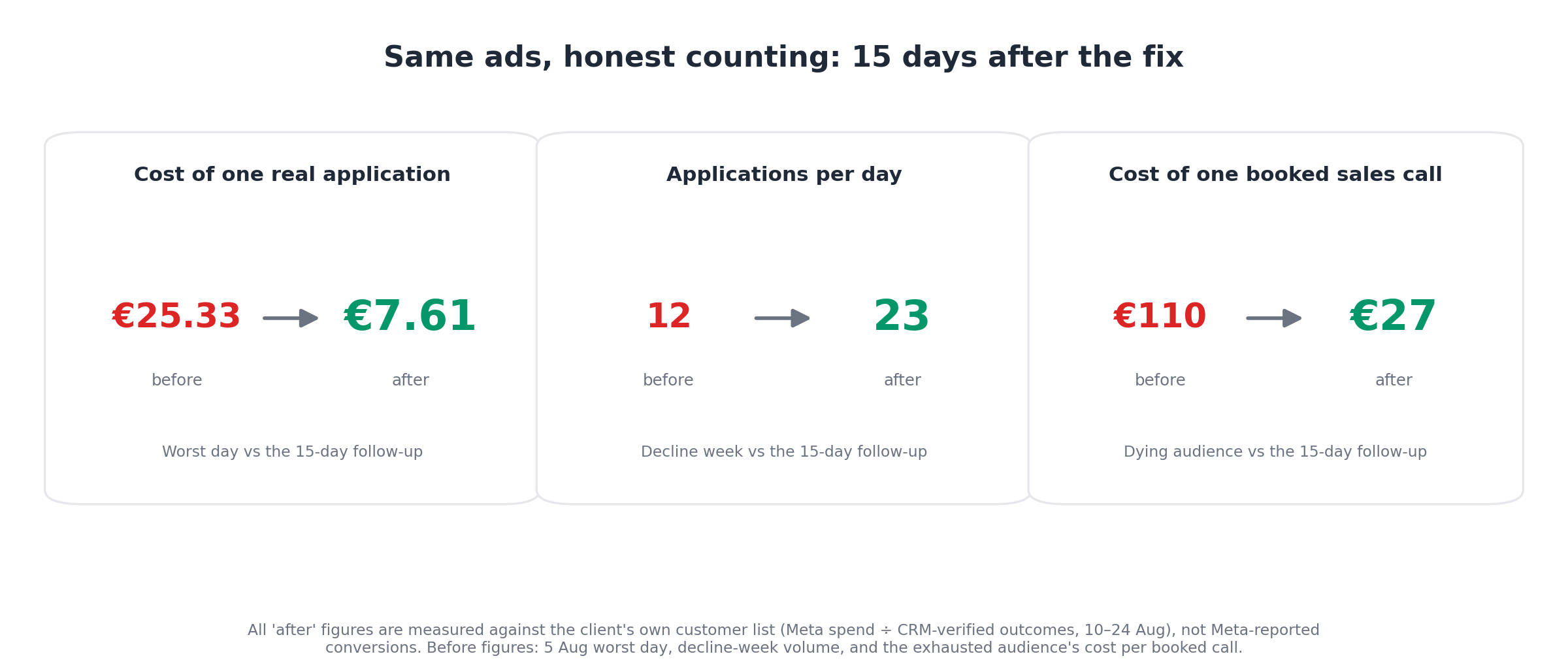
Left: the broken weeks. Right: the 15 days after the fix, measured against the client's own customer list — not Facebook's report.
What we measured | Worst point before | 15 days after the fix |
|---|---|---|
Cost of one real application | €25.33 | €7.61 |
Applications per day | about 12 | about 23 |
Cost of one booked sales call | €110 | about €27 |
One honest note, because honesty is the whole point of this story: the first four days after the fix looked even better (€4.74 per application, 41% of applicants booking calls). That early spike settled as the budget grew. What stayed is the part that matters — nearly double the volume at roughly a third of the worst-day cost.
Then Real Sales Happened
Cheap applications are nice. Booked tours are the point.
By 26 August, the client's sales team had closed eight unique tour sales, with €17,754.74 collected in deposits and €54,354 in booked tour value (one more tour's price is still being confirmed).
The two fastest ones show what a qualified lead looks like when the machine is aimed at real buyers:
- One person clicked an ad, applied, booked their own sales call two minutes later, and bought roughly 17 hours after first clicking.
- Another applied from an Instagram ad, booked their own call in under one minute, and bought roughly 95 minutes after applying. No salesperson chased either of them.
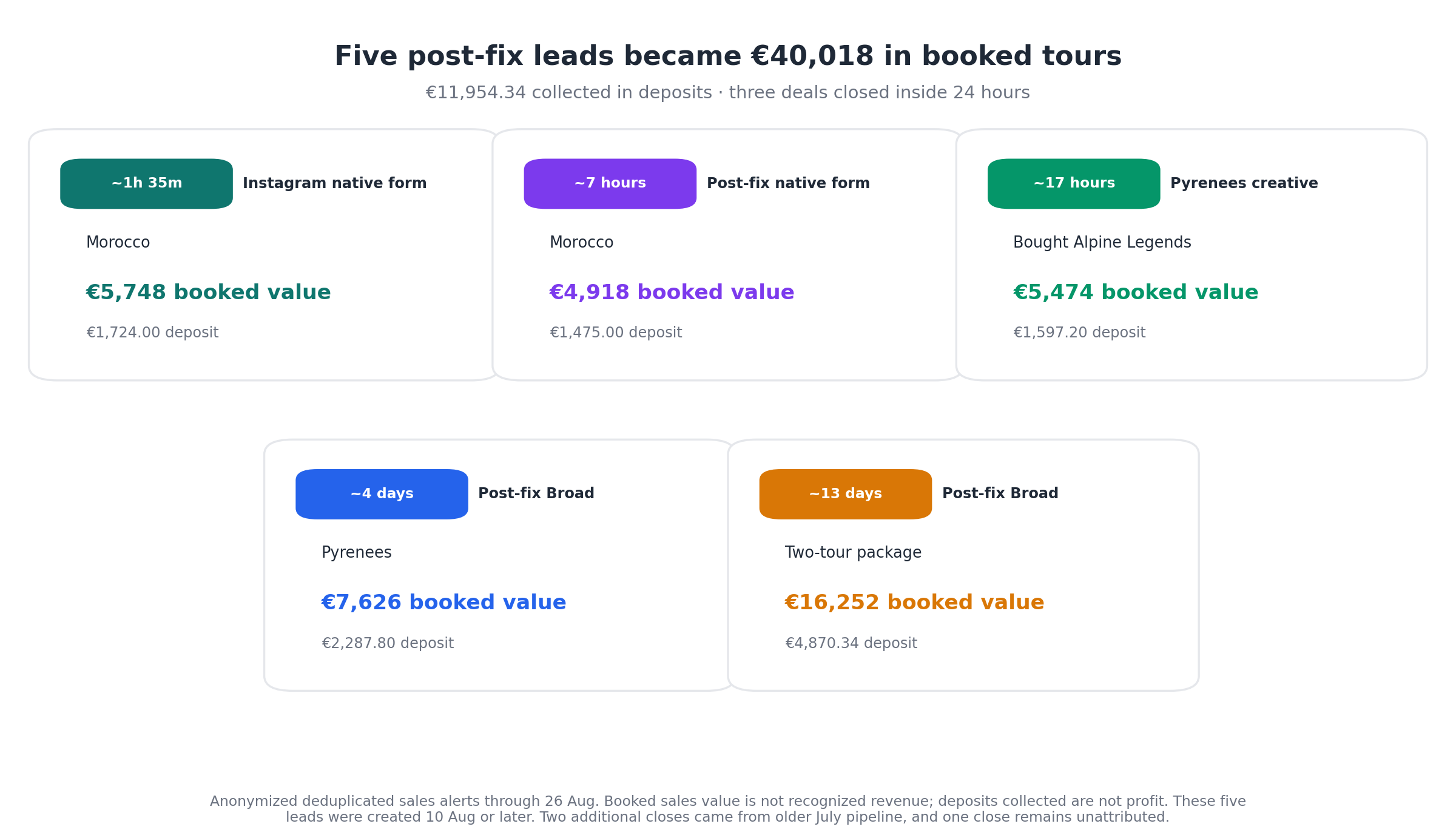
Five of the eight sales came from leads created after the fix. Three closed within 24 hours of the lead arriving.
Two honest words about these numbers, in plain language:
- "Booked tour value" is not profit. It means customers reserved tours and paid deposits. The tours happen later.
- Two of the eight buyers first showed up before the fix and simply took weeks to decide. We count them separately, because mixing them in would be its own kind of broken counter.
The One Lesson, Small Enough to Remember
Your ad platform's count and your real customer list must match.
That's it. That is the whole lesson. When they don't match, every euro you spend is being aimed by wrong numbers — and no amount of new creatives, budgets, or audiences will fix aim.
You can check your own ads today, no technical skills needed:
- Open Facebook's conversion count for last week. Write the number down.
- Open your own customer list (your CRM, your inbox, your spreadsheet) for the same week. Write that number down.
- Compare. If Facebook's number is much bigger — say 1.5× or 2× — your counter is broken, and fixing it comes before any other change.
The Tool That Does This Check Every Day
We did this rescue by hand in four days. The reason it took four days and not four weeks is that the same check — what the ad platform claims next to what actually happened — runs inside SimpleCheck as a daily view, not a one-off spreadsheet.
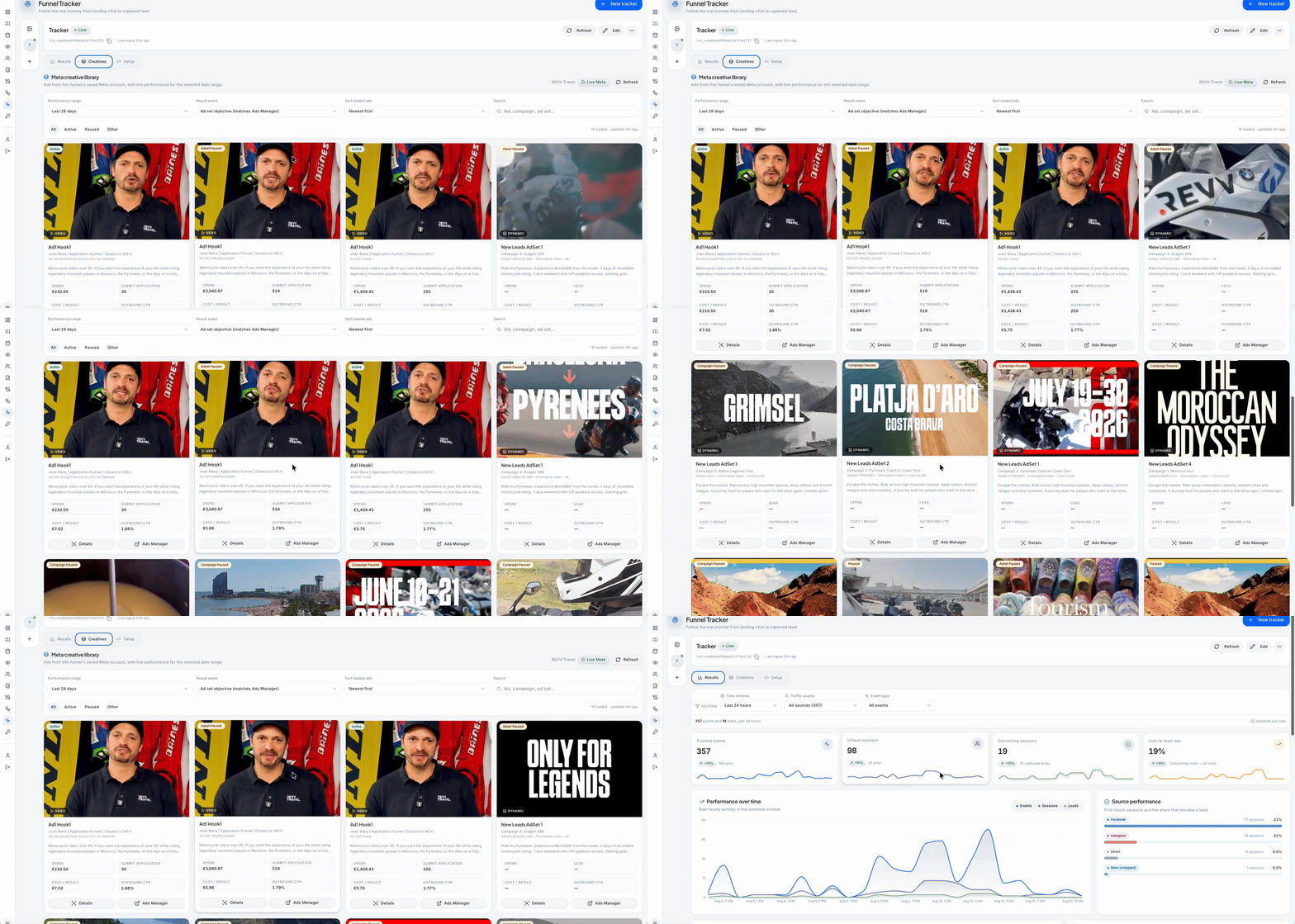
Your live ads on one side, the real captured visits and leads on the other — the two-column check from this story, running continuously.
Funnel Tracker watches every visit and matches leads back to the ad click that produced them — see Funnel Tracker: first-party attribution from ad click to lead. Pixel Wiring Studio is the honest counter: one clean server-side event per real action, never two. And Smart Routing checks each lead's quality in real time, so your ads learn from leads that book — not just leads that are cheap.
Fair scope, in plain words: Funnel Tracker tracks journeys and matches leads on your own pages; it is not call tracking or a revenue dashboard. The sales figures in this story came from the client's own sales reporting, checked and de-duplicated by hand.
Next Step
Do the two-number check from this article this week: Facebook's count next to your real customer count, same seven days.
If the numbers are close — great, your counting is honest. If they are far apart, that gap is where your ad budget has been going. Open Funnel Tracker in the portal, or message support from the portal chat with both numbers, and we'll help you read the gap.
Updated on: 29/08/2026
Thank you!