
The Pixel Fix Was Only Day One: How Clean Tracking Turned Into 343 Verified Applications, 98 Booked Calls, and €43,132 in Closed Tours
The Short Version
Two weeks ago we published the four-day rescue of REVV Travel's Meta account: a browser SubmitApplication event was firing on booking-page views, Meta was optimizing toward roughly twice as many conversions as existed, and 70% of budget sat in a hand-built "wealthy" audience that had stopped producing booked calls.
Four days after the fix the numbers looked spectacular. Four days flatters almost any campaign.
This is what happened over the next 15 complete days — and, for the first time, what happened to the money.
Metric | Decline week (Jul 30–Aug 5) | Four days after the fix | Follow-up window (Aug 10–24) |
|---|---|---|---|
Real cost per application (CRM-verified) | €11.64 (€25.33 worst day) | €4.74 | €7.61 |
Cost per booked call | €110 on the dying audience | €17.50 | €26.65 |
Completed applications per day | 12.4 | 16 | 22.9 |
Application-to-booked-call rate | 28% baseline, 8% at the end | 41% | 28.6% |
Read those last two rows together, because that is the honest story: the early efficiency spike normalized, and the account still ran at nearly double the application volume of the failure week at roughly a third of its worst-day cost.
Then the sales team started closing. In the eight days from 17–24 August, five unique customer groups booked tours worth €43,132 in booked sales value, with €12,933.54 in deposits collected. Three of those five were leads acquired after the fix.
Postscript, 26 August: three further sales arrived after those fixed reporting windows closed. A paid-Facebook lead self-booked through the widget in two minutes and closed on the first sales call roughly 17 hours later. REVV then reported another Pyrenees close with a €1,500 deposit, although its acquisition details and tour value are still pending. The latest result moved even faster: a paid-Instagram native-form lead self-booked in under one minute, took the sales call 13 minutes after applying, and closed on that first call roughly 1 hour 35 minutes after entering the funnel. The running ledger is now eight unique closes and €17,754.74 in deposits collected, with €54,354 in known booked sales value plus one tour total still pending. None of these sales is folded into the fixed Aug 10–24 acquisition metrics above.
What the First Article Established
Briefly, so this piece stands alone.
REVV was running two conversion sources with no deduplication: a browser SubmitApplication event placed in the booking page header (so it fired on page views, not submissions), and a server-side CAPI event on the real form submission. They shared no event_id, so Meta counted both.
Window | CRM applications | Pixel | Pixel ÷ CRM |
|---|---|---|---|
Before CAPI (Jul 15–21) | 164 | 133 | 0.8× — normal browser loss |
First CAPI week (Jul 22–28) | 196 | 443 | 2.3× |
Decline week (Jul 30–Aug 5) | 87 | 193 | 2.2× |
The fix removed the page-view conversion, kept the real server-side submission, paused the "wealthy" interest stack, launched a broad no-interest twin, and put a €6 cost-per-result cap on the campaign. Four days later real cost per application had fallen from a €25.33 worst day to €4.74.
That is where the last article ended. It ended too early to answer the only question that matters to a business: did any of this turn into tours? A one-page version of this story is here: The Simple Version. For the sales-quality follow-up, see what reached the sales team afterward.
Fifteen Days Later: 343 Verified Applications
From 10–24 August REVV spent €2,611.28 on Meta. Their CRM recorded 343 new paid-Meta contacts who completed the application.
That last word is doing real work. This is not a count of Meta-attributed conversion events — it is new contacts from paid Meta with a CRM-verified completed application, which is a deliberately stricter number.
Metric | Follow-up window (Aug 10–24) |
|---|---|
Meta spend | €2,611.28 |
New funnel contact records | 437 |
Completed applications (all sources) | 347 |
Completed applications (paid Meta) | 343 |
Partial form records | 90 |
Completed applications per day | 22.9 |
Contacts with a booked-call signal | 98 |
Application-to-booked-call rate | 28.6% |
Matured portion of the cohort | 247 apps → 72 booked calls (29.1%) |
Blended spend per completed application | €7.61 |
Blended spend per booked-call contact | €26.65 |
Against the failure state:
- Application volume went from 12.4/day in the decline week to 22.9/day — about 84% more, and about 43% above the immediate 16/day recovery level.
- Real acquisition cost was €7.61, roughly 35% below the decline week's €11.64 and 70% below the €25.33 worst day.
- Cost per booked call was €26.65, roughly 76% below the €110 the dying audience was charging per appointment.
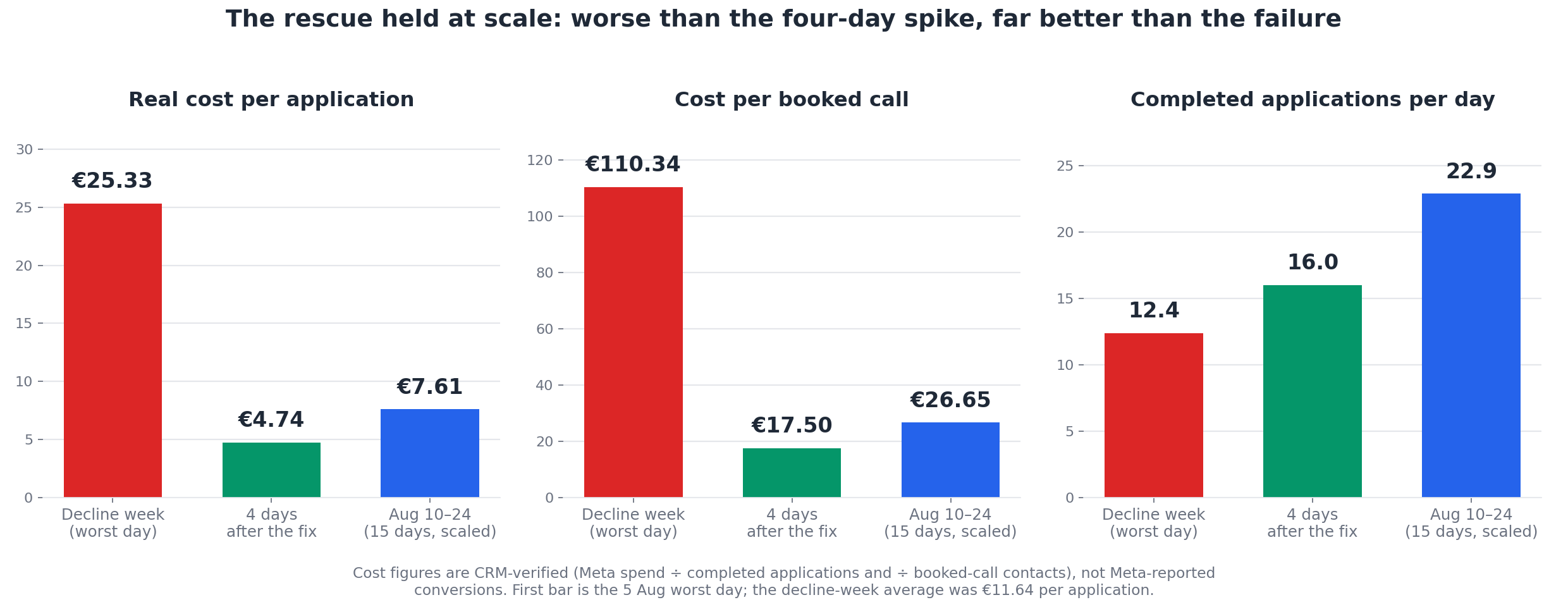
Three phases, three metrics. The middle bar is the four-day spike; the right bar is the same system running at nearly double the volume. Higher than the spike, far better than the failure.
The Honest Part: 41% Was a Spike, Not a Plateau
The 41% application-to-booked-call rate from the fix week did not survive contact with scale. The 15-day cohort settled at 28.6% — 29.1% for the more mature portion.
We are stating that plainly because the alternative is the kind of case study nobody should trust.
It still matters commercially:
- It is essentially level with REVV's historical 28% baseline, while processing substantially more applications.
- The core web-form audiences held up much better than the blend: Broad and Travel together produced 143 applications and 51 booked-call tags — a 35.7% rate.
- The blend was dragged down by a first experiment with Meta native lead forms, which produced cheap application volume at a 9.1% scheduled-call rate.
That is the scaling lesson, and it generalizes: early efficiency peaks normalize as budget, creatives, and lead sources expand. The right question is not "did every metric stay at its peak" — it is "is the system still materially better than the failure state, and is it producing pipeline." Here, both.
The Budget Allocation Flipped
Before the rescue, roughly 70% of spend flowed into the hand-built "wealthy" interest stack. During the follow-up window it took 18.3%, while broad, no-interest creative tests, and native experiments took about 69.7%.
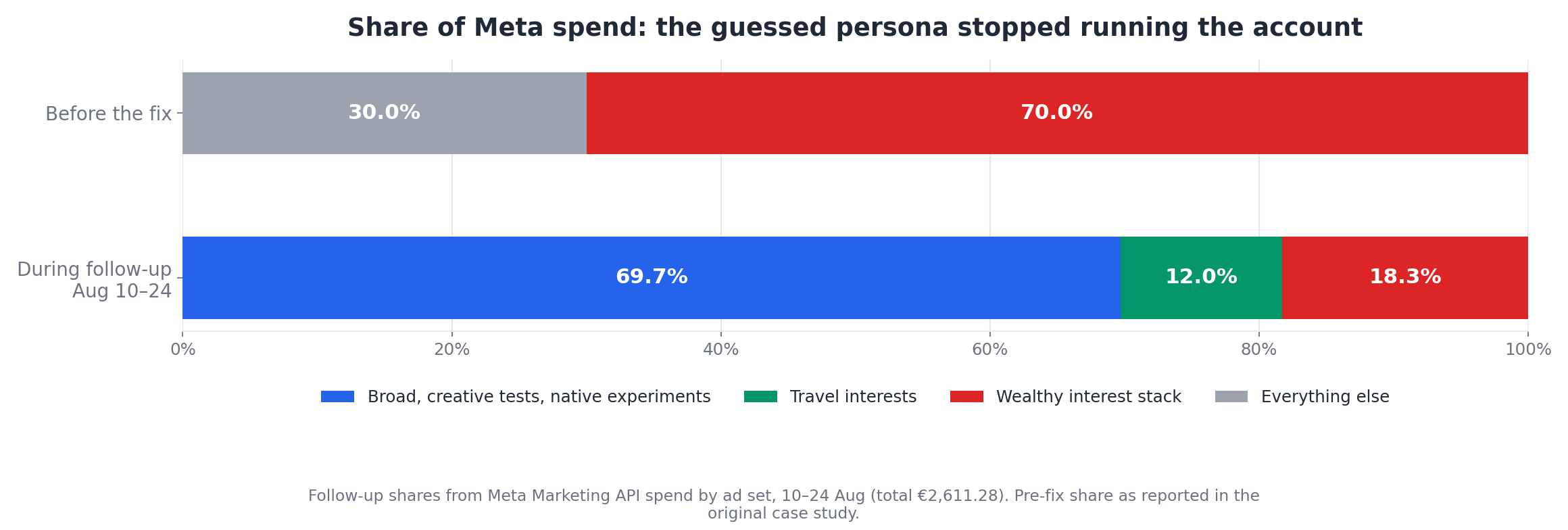
The guessed persona stopped controlling the account. Most spend moved to broad, algorithm-led, and creative-led acquisition.
Per acquisition stream — the booked-call column uses the durable appointment_scheduled CRM tag so per-stream numbers stay consistent:
Acquisition stream | Spend | CRM apps | Booked-call tags | Booking rate | € / app | € / booked call |
|---|---|---|---|---|---|---|
Broad, combined | €956.76 | 107 | 38 | 35.5% | €8.94 | €25.18 |
Travel interests | €312.39 | 36 | 13 | 36.1% | €8.68 | €24.03 |
Wealthy interests | €478.30 | 68 | 18 | 26.5% | €7.03 | €26.57 |
Initial native-form test | €407.03 | 55 | 5 | 9.1% | €7.40 | €81.41 |
Morocco V4 creative test | €131.78 | 24 | 5 | 20.8% | €5.49 | €26.36 |
Pyrenees creative test | €130.27 | 24 | 6 | 25.0% | €5.43 | €21.71 |
Transpirenaica paid creative | €98.04 | 22 | 7 | 31.8% | €4.46 | €14.01 |
Morocco V2 paid creative | €85.19 | 5 | 0 | 0% | €17.04 | n/a |
Transpirenaica native test | €11.52 | 2 | 1 | 50.0% | €5.76 | €11.52 |
Four things worth taking away:
- Broad stayed the largest scalable source and still converted to calls at 35.5%. The thing that replaced the persona did not fall apart when it got most of the budget.
- Travel interests remained efficient at turning applications into calls (36.1%) — this was never an argument that all interest targeting is bad.
- Wealthy recovered from its terminal 8% to 26.5%, but still trailed both broader sources. Recovering is not the same as earning the budget back.
- Cheap leads are not qualified leads. The initial native-form test looked fine at €7.40 per application and was the worst line in the table at €81.41 per booked call. Cost per lead would have told you to scale it.
The newer Transpirenaica native sample produced one booking and one close from two leads. Promising, and far too small to generalize — we are reporting it, not recommending it.
Then the Bell Started Ringing
REVV's internal sales channel posted six "new tour closed" alerts between 17 and 24 August. One customer's deposit was posted twice, so the deduplicated result is five unique closed customer groups.
Lead cohort / source | Lead created | Closed | Time to close | Product | Deposit | Booked sales value |
|---|---|---|---|---|---|---|
Post-fix Broad | Aug 13 | Aug 17 | ~4 days | Pyrenees | €2,287.80 | €7,626 |
Post-fix Broad (earlier) | Aug 10 | Aug 23 | ~13 days | Two-tour package | €4,870.34 | €16,252 |
Older Wealthy cohort | Jul 27 | Aug 24 | ~28 days | Pyrenees | €1,958.00 | €6,528 |
Older Travel cohort | Jul 1 | Aug 24 | ~54 days | Morocco | €2,342.40 | €7,808 |
Post-fix native form | Aug 24 | Aug 24 | ~7 hours | Morocco | €1,475.00 | €4,918 |
Total | €12,933.54 | €43,132 |
Three of the five were acquired during the post-fix follow-up window, accounting for €8,633.14 in deposits and €28,796 in booked sales value.
The other two came from July leads that matured during the same week — one at 28 days, one at 54. That is not a flaw in the result, it is the reason lead history has to survive across weeks. Spend creates pipeline, and pipeline converts on its own schedule.
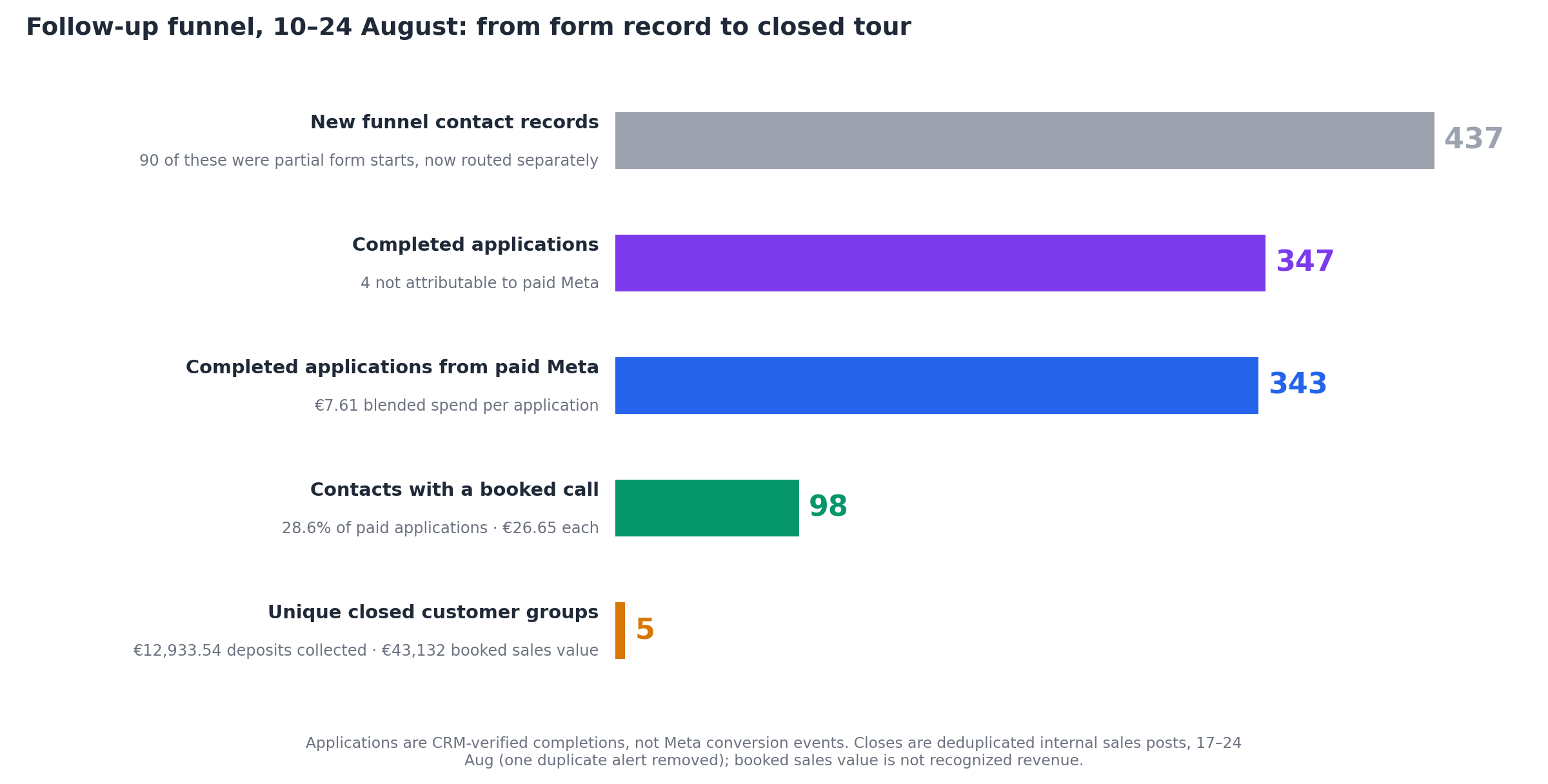
437 records in, 347 completed applications, 343 from paid Meta, 98 booked calls, 5 closed customer groups.
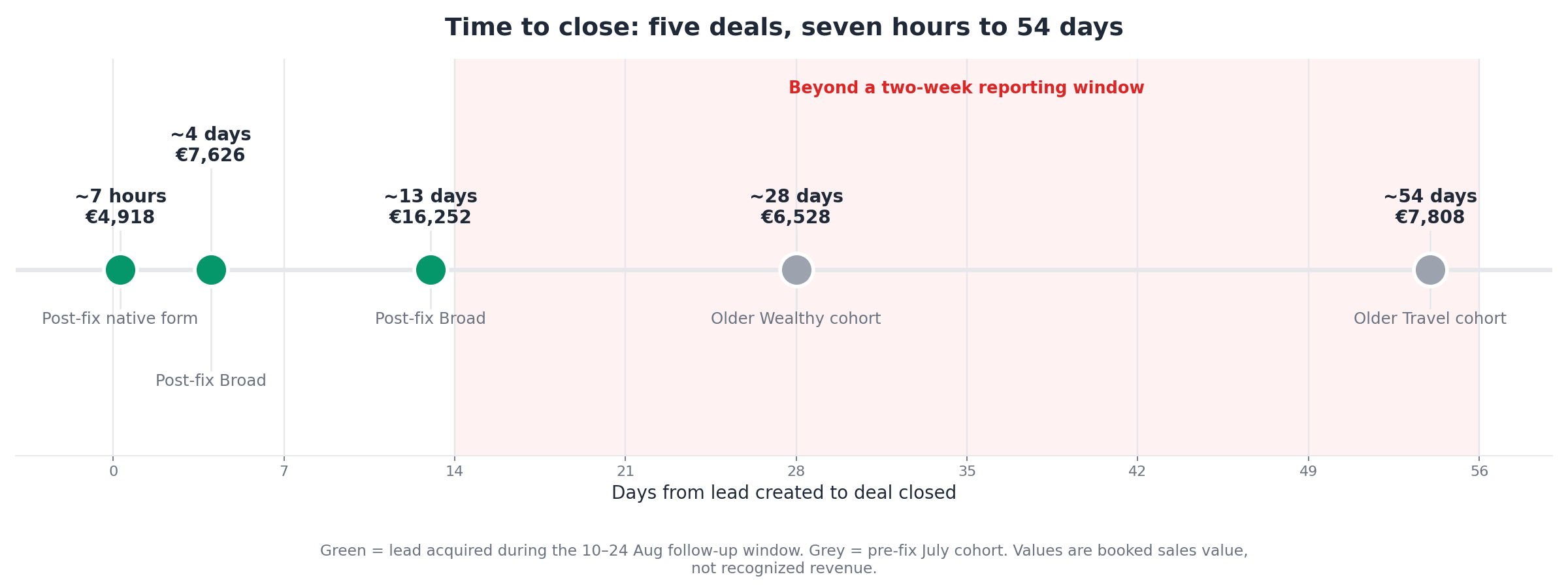
Seven hours to 54 days. Any attribution window shorter than ~8 weeks would have missed two of these five entirely.
Why We Are Not Calling This 16.5× ROAS
Two deliberate pieces of vocabulary, because this is where case studies usually get dishonest:
- €43,132 is booked sales value, not recognized revenue. Tours are delivered later; cancellations and changes happen.
- €12,933.54 is deposits collected, not profit. It is cash in, before delivery cost or margin.
The tempting arithmetic is €43,132 ÷ €2,611.28 = 16.5×. We are showing that calculation instead of hiding it, but we are not labeling it ROAS. Two of the five closes came from pre-fix July cohorts, while the 15-day acquisition cohort is still maturing. The numerator and denominator do not describe the same set of leads, and booked future tour value is not recognized revenue. Calling the result ROAS would create more certainty than the evidence supports.
Postscript — 26 August: Booked in Two Minutes, Closed on the First Call
After the reporting windows above had closed, another qualified result came in. We are keeping it separate rather than silently moving the date boundaries.
Fact | Verified outcome |
|---|---|
Lead arrived | Aug 25 at 7:07 PM EDT |
Source | Paid Facebook · Pyrenees creative test |
Device and form | Android in-app browser · Application Form v2 split test |
Qualification | Completed · willing to fly: Yes · can invest: Yes |
Booking | Self-booked through the widget two minutes later · no setter |
Sales result | Closed on the first call on Aug 26 · roughly 17 hours after applying |
Product | Alpine Legends with VIP insurance |
Commercial result | €1,597.20 deposit collected · €5,474 booked sales value |
The lead came through a Pyrenees ad and bought an Alps tour. That is a useful qualification signal: the creative attracted a buyer for the broader travel offer, not only somebody clicking for one exact itinerary.
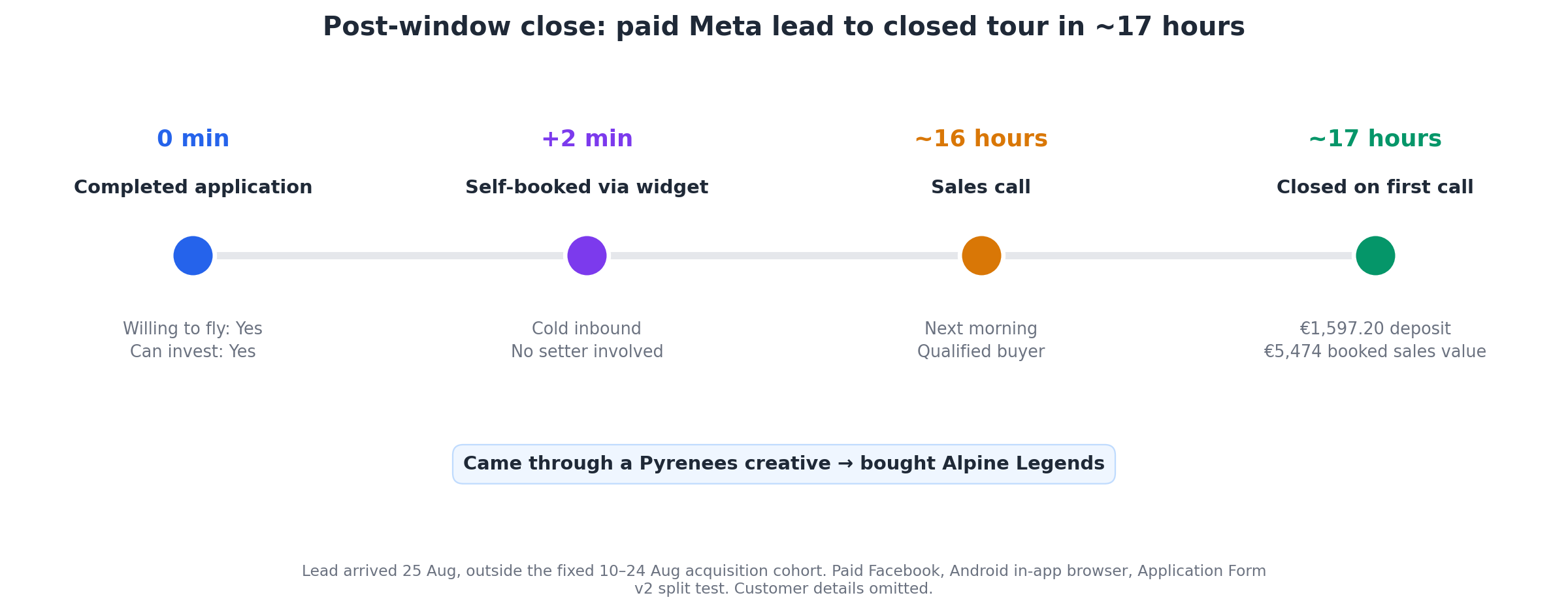
Completed application → self-booked in two minutes → first-call close roughly 17 hours later. Customer details are deliberately omitted.
Later the Same Day: An Unattributed Seventh Close
REVV then reported another closed seven-day Pyrenees tour for May 2027, with a €1,500 deposit collected. The lead-created date, acquisition source, and total tour price were not available in the sales alert, so this close remains unattributed rather than being assigned to the post-fix cohort.
An Eighth Close: Instagram Native Lead to Sale in ~95 Minutes
The next result had a complete acquisition trail and is kept as a separate post-window observation:
Fact | Verified outcome |
|---|---|
Lead arrived | Aug 26 at 1:47 PM EDT |
Source | Paid Instagram · native lead form · broad, no-interest audience |
Device and form | Android in-app browser · Meta Instant Form |
Booking | Self-booked through the widget in under one minute · no setter |
Sales result | Call began 13 minutes after applying · closed on the first call roughly 1 hour 35 minutes after arrival |
Product | Morocco tour |
Commercial result | €1,724 deposit collected · €5,748 booked sales value |
This is commercially important and still only one sale. It does not erase the fixed-window finding that the first native-form test produced a 9.1% tagged-booking rate. It does show why source quality should keep being measured through the calendar and deposit—not decided from cost per form fill alone.
Ledger cut | Unique closes | Deposits collected | Booked sales value |
|---|---|---|---|
Verified close window, Aug 17–24 | 5 | €12,933.54 | €43,132 |
First-call post-window close, Aug 26 | 1 | €1,597.20 | €5,474 |
Latest Pyrenees close, cohort pending | 1 | €1,500.00 | Pending |
Instagram native-form first-call close, Aug 26 | 1 | €1,724.00 | €5,748 |
Running observed total through Aug 26 | 8 | €17,754.74 | €54,354 known + one pending |
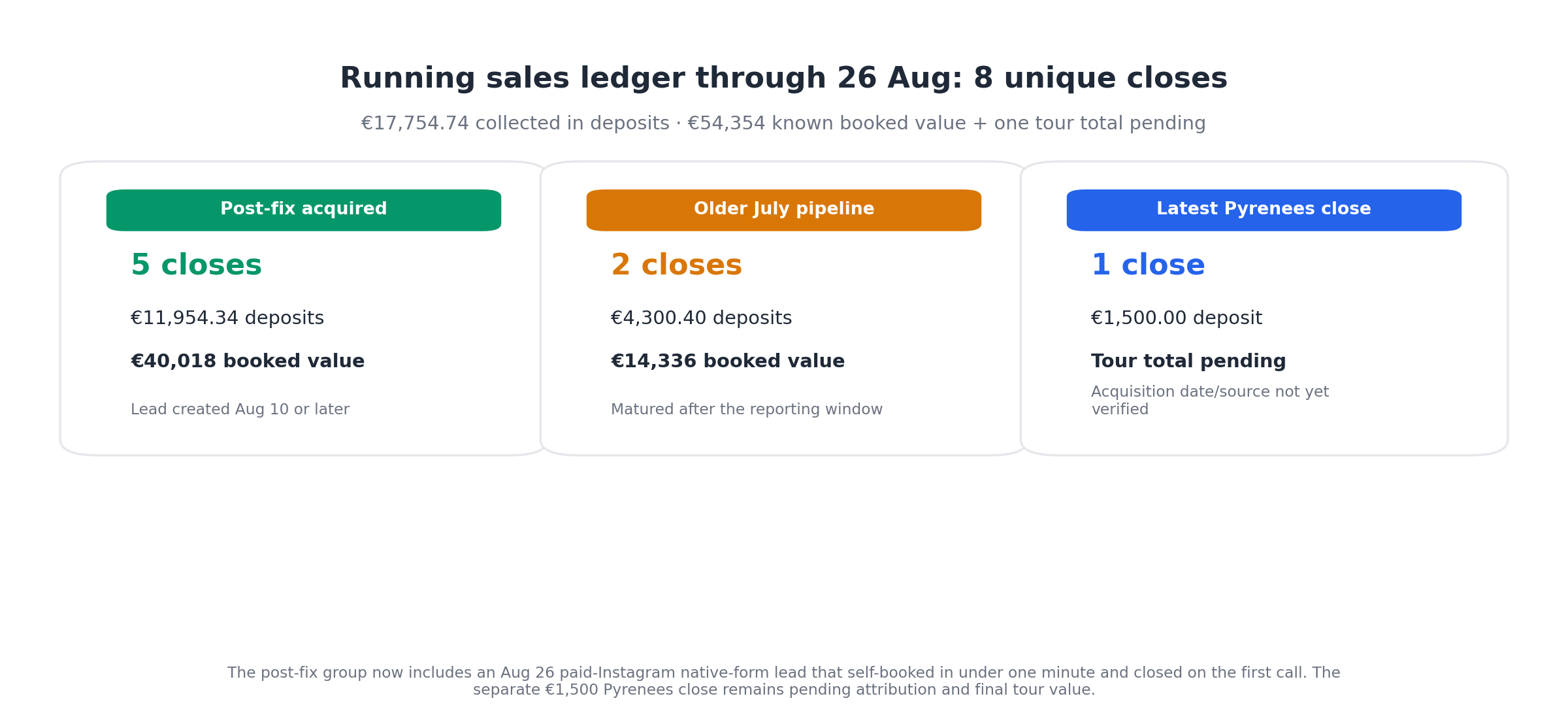
Eight unique closes and €17,754.74 collected in deposits. Five are verified as leads created on or after 10 August; one tour stays outside cohort reporting until its source and lead-created date are verified.
Five of the eight observed closes are verified as leads created on or after 10 August. Together those five account for €11,954.34 in deposits collected and €40,018 in booked sales value. The unattributed Pyrenees close is not added to either side of that cohort calculation yet.
Two fast closes do not prove that a pixel repair caused either sale. The pixel fix did not create buyer intent or close the tours; it stopped Meta learning from phantom submissions and restored a real completed application as the optimization signal. The downstream behavior is what matters: completed qualifications, self-bookings with no setter, and first-call closes.
Using the €54,354 of currently known booked value would make the tempting cross-window calculation 20.8× before the pending tour price is even added. We still do not call that ROAS: the total includes two July leads plus Aug 25 and Aug 26 post-window leads, while the spend denominator remains Aug 10–24. The unattributed close has neither a verified acquisition date nor a final booked value yet. More sales strengthen the commercial evidence; they do not repair the cohort mismatch.
Clean Tracking Has to Continue Past the Ad Click
The first article was about Meta event hygiene. The follow-up found the same class of problem living one system further down: the CRM (GoHighLevel) can recreate a broken pixel's reporting failure without any pixel involved.
In the follow-up window the CRM held 437 funnel records: 347 completed applications and 90 partial form records. Left together, form starts look like submissions — which is precisely the mistake the browser event was making on the ad platform side. Partials are now separated and routed into a dedicated partial-submission workflow; contacts with no opportunity are re-checked every five minutes and enrolled into the matching partial or completed flow.
The other measurement traps we hit, all real:
- Two customers who had paid were still sitting outside Closed-Won — one in Follow-Up, one in Closed-Lost. Pipeline stage was therefore unusable as a revenue source.
- One close alert was posted twice, which would have inflated deposits by €1,475 and booked value by €4,918 if counted naively.
- A self-booked call can be credited to a staff setter if nobody checks.
So each fact now comes from the system that actually owns it:
Fact | Source of truth |
|---|---|
Spend and delivery | Meta |
Real applications | Completed CRM application fields |
Booked calls | CRM appointment records |
Closed deals and cash | Deduplicated sales close posts |
Not one perfect dashboard number — a short chain of facts that agree closely enough to act on. That is the same conclusion as the pixel fix, applied one layer deeper.
How We Counted
Method, so you can reproduce it on your own account:
- Spend: Meta Marketing API by ad set, 10–24 August inclusive, account timezone Europe/Madrid.
- Completed application: a native lead-form completion tag, or non-empty application fields (invest / willing-to-fly).
- Paid Meta: a captured Meta ad or ad-set identifier,
utm_source=fb_ad, or a native Facebook source. - Booked call: the
appointment_scheduledtag, or an appointment record on the contact. - Close: deduplicated internal close posts reporting deposit amounts, 17–24 August.
Two reconciliation notes we would rather publish than paper over:
- Per-stream rows sum to 93 booked-call tags; five further contacts had appointment records without the tag, which is why the headline booked-call figure is 98. The stream table uses the tag alone so per-stream rates stay comparable.
- Meta reported more attributed
SubmitApplicationactions than the number of newly created completed CRM contacts in this window. That is not a deduplication test. A returning contact can submit without generating a new CRM creation timestamp, and native forms emit their own action types — the two counts are not directly comparable. We are not claiming from this number that dedupe is still perfect; we are claiming the commercial outputs held.
The 15-day cohort is also still maturing. Later bookings and closes can only move its downstream rates up.
What This Follow-Up Proves
The original rescue was not a lucky four-day bounce.
At nearly double the volume, the account still produced applications and booked calls far below the cost of the failure period. Broad targeting kept outperforming the hand-built persona. Native forms demonstrated why cheap leads still need downstream qualification. Within the verified close window, the pipeline converted into five real closes worth €43,132 in booked tours. One post-window lead then self-booked in two minutes and closed on the first call roughly 17 hours later; another close remains unattributed; and a paid-Instagram native-form lead self-booked in under one minute and closed on the first call roughly 95 minutes after applying. The running ledger now stands at eight unique sales.
The rule from day one holds, and it now has collected cash and booked sales value behind it:
Trust the CRM over the pixel, trust booked calls over form fills, and trust collected deposits over pipeline labels.
How SimpleCheck Bakes This In
Both halves of this story — the pixel audit and the CRM audit — are checks that should run continuously, not during an emergency.
Funnel Tracker is the continuous version of the audit in this article: first-party capture of every visit, UTMs and click IDs, live Meta spend next to real captured leads, and each lead matched back to the session that produced it — so "what Meta claims" and "what actually happened" sit side by side instead of in two spreadsheets. See Funnel Tracker: first-party attribution from ad click to lead.
Setup → Results → Creatives — live Funnel Tracker walkthrough at 1.5×.
For the delivery side — one clean server-side event per real action, with event identity handled so browser and server never double-count — see Pixel Wiring Studio. And the lead-quality half, which is the entire lesson of the €81.41 native-form line above, is what Smart Routing does on the form you already run: qualify each submission in real time so ads optimize on leads that book. More on the mechanics in Ad Performance: how SmartForm improves ROAS.
Scope honesty, because trust is the product: Funnel Tracker is first-party journey tracking and lead matching — not call tracking, revenue modeling, or a deal ledger. The close and deposit figures in this article came from REVV's own sales reporting, deduplicated by hand. Pixel Wiring covers Meta CAPI for SmartForm funnel events; it is not a multi-channel attribution suite.
Next Step
If you only do one thing from this article, do the two-column check: one window of pixel conversion events next to one window of CRM-verified completed applications. If the ratio is meaningfully above 1, your optimization has been learning from events that never happened.
Then do the second check, the one this follow-up added: take last month's closed deals and find the date each lead was created. If any of them are older than your reporting window, your ad spend is building pipeline your dashboard is not crediting.
Open Funnel Tracker in the portal — or message support from the portal chat with your Ads Manager count and CRM count for the same week, and we'll help you read the gap.
Updated on: 29/08/2026
Thank you!