
Meta Lead Quality After the Pixel Fix: 83% Passed Both Gates and Three Leads Closed Inside 24 Hours
The Short Version
Fixing REVV Travel's Meta signal did not just lower acquisition costs. It changed what reached the sales team.
From 10–26 August, GoHighLevel recorded 390 completed applications attributable to paid Meta. Of those applicants:
- 334 of 385 respondents (86.8%) said they had the cash or credit to invest in a premium motorcycle expedition.
- 377 of 385 respondents (97.9%) said they were willing to fly for the experience.
- 324 of all 390 applicants (83.1%) passed both qualification gates.
- 113 (29.0%) already had a booked-call signal by the 26 August audit.
Then came the outcome sales teams actually care about: five leads acquired on or after 10 August closed into €40,018 in booked sales value, with €11,954.34 in deposits collected. Three closed inside 24 hours. The fastest self-booked through the widget in under one minute and closed on the first call roughly 1 hour 35 minutes after applying.
That is the story here: not cheaper form fills, but more people who could buy, would travel, booked calls, and started buying tours.
Late 26 August update: after the GHL quality snapshot was pulled, REVV reported two more sales. One was a seven-day Pyrenees tour with a €1,500 deposit collected; its lead-created date, acquisition source, and full tour value are still pending. The other had a complete trail: paid Instagram, native lead form, self-booked in under one minute, first-call close roughly 95 minutes after applying, €1,724 deposit collected, and €5,748 in booked sales value. The running ledger now contains eight unique sales. These updates do not change the frozen 390-application quality snapshot above.
“Lead Quality” Needs a Definition
Meta can report a conversion. A CRM can hold a contact. Neither proves the sales team received a qualified buyer.
For this review, a lead moved through four progressively harder gates:
- Completed application — not a partial form record.
- Self-reported fit — willing to fly and able to invest.
- Commercial intent — booked a sales call.
- Commercial outcome — a deduplicated close with a deposit reported by sales.
That definition matters because the original tracking problem counted booking-page views as SubmitApplication conversions. An event could look successful inside Meta without a completed applicant existing at all.
The repair removed that page-view event and kept the real server-side application signal. It also shifted spend away from the exhausted hand-built “wealthy” audience and into broader, creative-led acquisition. You can read the original four-day pixel rescue here.
This article starts where that one stopped: what did sales receive afterward? A one-page version of the whole rescue is here: The Simple Version. The 15-day follow-up has the acquisition numbers behind this sales review. The next article goes back one step, to the visitors who never became leads at all: AI session replay found the funnel leak.
390 Paid-Meta Applications, Measured Against Real Qualification Gates
The combined quality snapshot contains two deliberately separate pieces:
Cohort | Paid-Meta completed applications | Passed both gates | Booked-call contacts as of Aug 26 |
|---|---|---|---|
Complete follow-up window, Aug 10–24 | 343 | 281 | 102 |
Post-window pulse, Aug 25–26 | 47 | 43 | 11 |
Combined snapshot | 390 | 324 | 113 |
The 26 August day was still in progress when the data was pulled, and the newest 47 applicants had less than two days to book. Their current booking rate is therefore an early floor, not a final cohort rate.
The complete Aug 10–24 cohort continued maturing after the first follow-up report. By the Aug 26 audit it had reached 102 booked-call contacts, or 29.7% of the 343 paid-Meta completed applications.
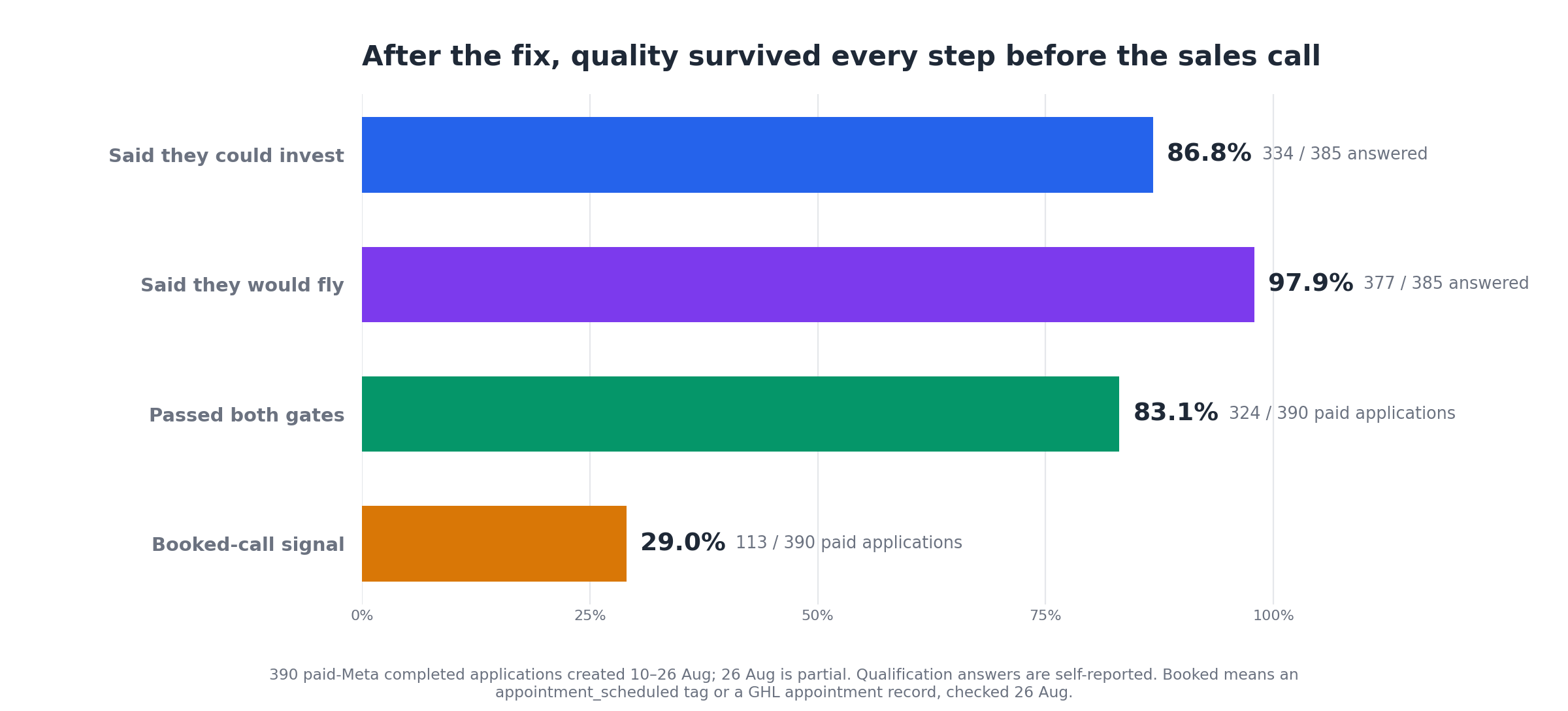
Qualification remained high before sales entered the conversation: 83.1% passed both gates and 29.0% already had a booked-call signal.
The answers are self-reported. “Yes” to an investment question is not verified net worth, and it is not a sale. But the progression from both gates passed → booked call → deposit collected is much stronger evidence than a platform conversion count.
The newest post-window group was particularly strong:
- 47 paid-Meta completed applications
- 45 of 47 answered yes to the investment gate
- 45 of 46 respondents answered yes to willingness to fly
- 43 of 47 (91.5%) passed both gates
- 11 already had a booked-call signal
- 1 had already closed on the first call
We are not presenting two partial days as a stable rate. We are presenting the facts that existed by the audit time.
The Fastest Way to See Bad Lead Quality: Look Past Cost per Lead
One test made the lesson impossible to miss.
Acquisition stream, Aug 10–24 | Applications | Booked-call tags | Booking rate | Cost per application | Cost per tagged booking |
|---|---|---|---|---|---|
Broad | 107 | 38 | 35.5% | €8.94 | €25.18 |
Travel interests | 36 | 13 | 36.1% | €8.68 | €24.03 |
Wealthy interests | 68 | 18 | 26.5% | €7.03 | €26.57 |
Initial native-form test | 55 | 5 | 9.1% | €7.40 | €81.41 |
The native test looked acceptable if the report stopped at cost per application. It became the weakest major source when the denominator changed to booked calls.
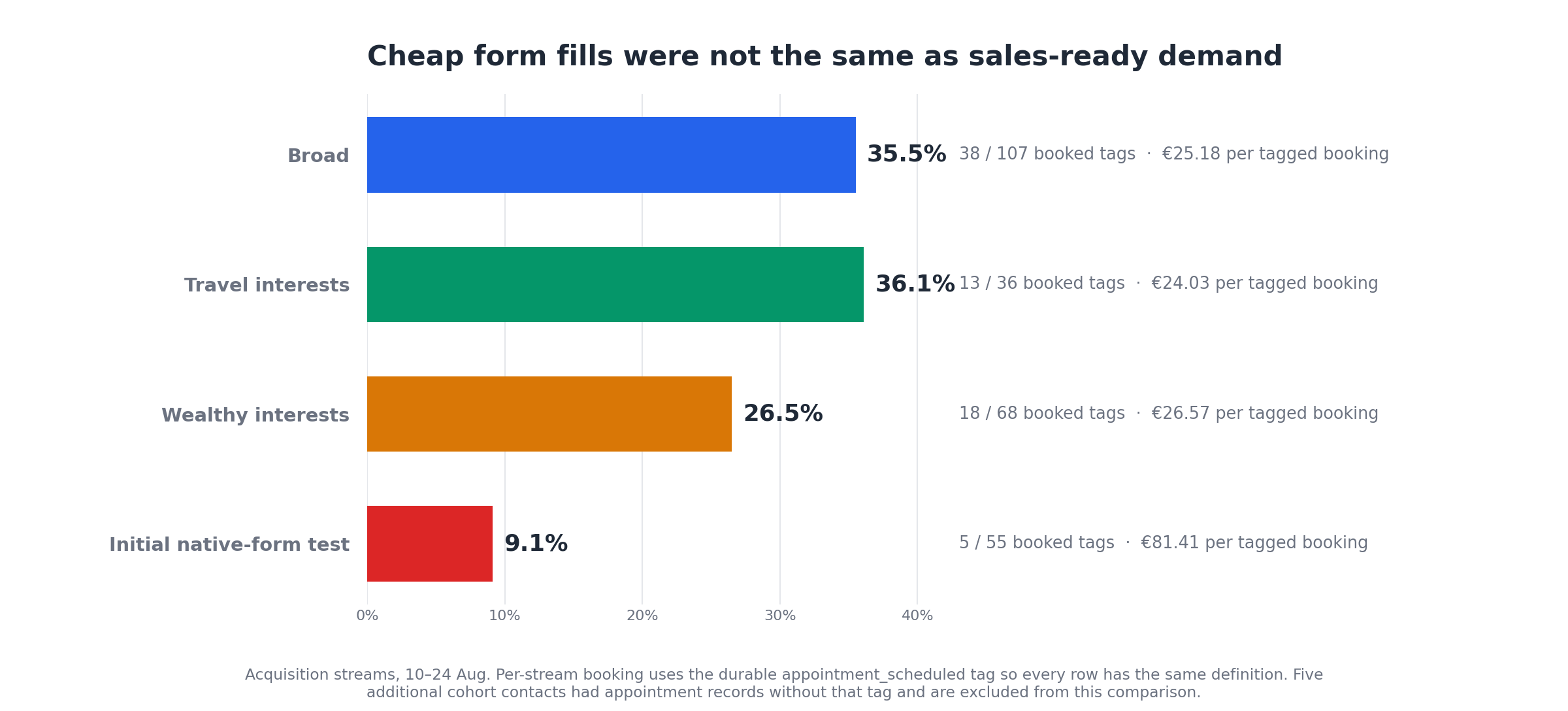
Broad and Travel turned roughly 36% of applications into booked-call tags. The first native-form test converted only 9.1%.
This is why “qualified lead” cannot mean “the form was cheap.” Broad and Travel together produced 143 applications and 51 booked-call tags, a 35.7% booking rate. The initial native test produced plenty of form volume, but sales received a much thinner appointment pipeline.
The correct optimization question was no longer:
Which source generates the cheapest application?
It became:
Which source repeatedly sends applicants who pass the gates and book?
Five Post-Fix Leads Turned Into €40,018 in Booked Tours
The sales ledger gives the qualification data commercial weight.
Five customers acquired on or after 10 August closed by the end of 26 August:
Acquisition source | Lead created | Time to close | Product | Deposit collected | Booked sales value |
|---|---|---|---|---|---|
Post-fix Broad | Aug 13 | ~4 days | Pyrenees | €2,287.80 | €7,626 |
Post-fix Broad | Aug 10 | ~13 days | Two-tour package | €4,870.34 | €16,252 |
Post-fix native form | Aug 24 | ~7 hours | Morocco | €1,475.00 | €4,918 |
Pyrenees creative test | Aug 25 | ~17 hours | Alpine Legends | €1,597.20 | €5,474 |
Instagram native lead form | Aug 26 | ~1 hour 35 minutes | Morocco | €1,724.00 | €5,748 |
Post-fix acquisition total | €11,954.34 | €40,018 |
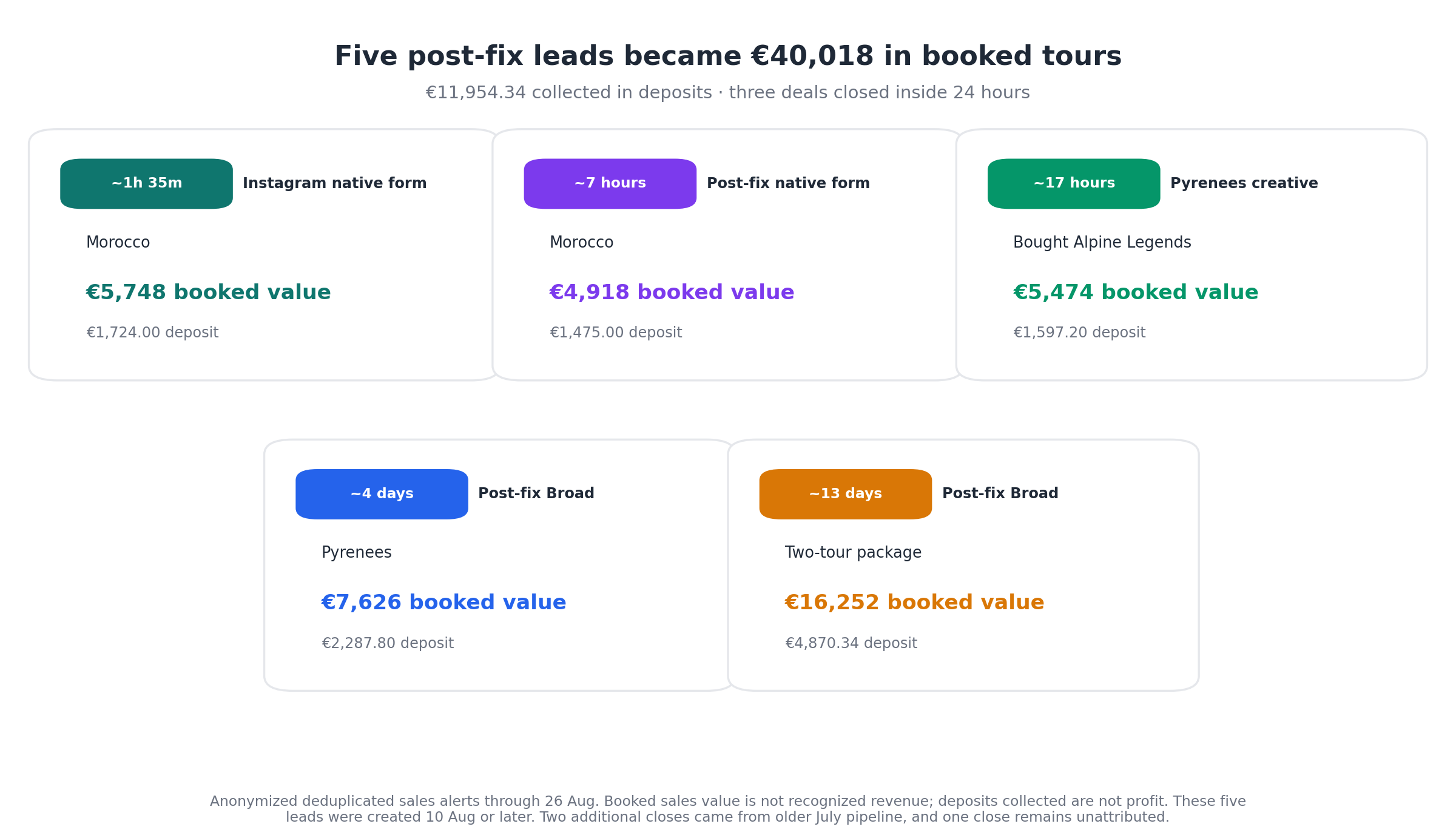
Three post-fix leads closed inside 24 hours. All five closed within 13 days of entering the CRM.
Two older July leads also closed during the observed sales period. Keeping those older deals separate matters: they demonstrate pipeline maturation, but they were not created by the Aug 10–26 acquisition cohort.
The running deduplicated ledger through 26 August was:
Ledger cut | Unique closes | Deposits collected | Booked sales value |
|---|---|---|---|
Leads created Aug 10 or later | 5 | €11,954.34 | €40,018 |
Older July pipeline | 2 | €4,300.40 | €14,336 |
Latest Pyrenees close, cohort pending | 1 | €1,500.00 | Pending |
Running observed total | 8 | €17,754.74 | €54,354 known + one pending |
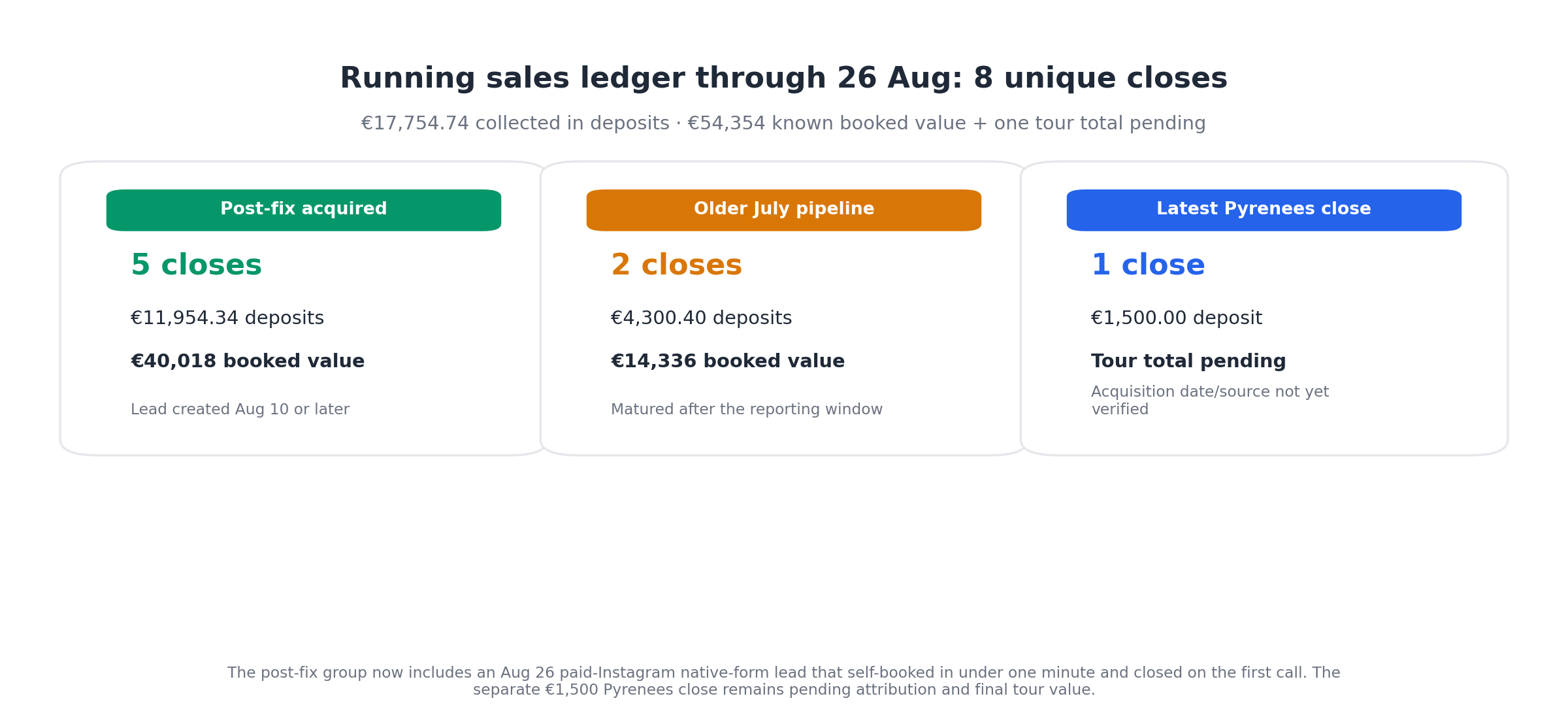
The current ledger has eight unique closes and €17,754.74 in collected deposits. Five are verified as leads created on or after 10 August; one sale remains unattributed until its source and lead-created date are verified.
Two vocabulary rules keep this honest:
- Booked sales value is not recognized revenue. The tours are delivered later.
- Deposits collected are not profit. Delivery costs, changes, and cancellations still exist.
We also do not divide those values by the Aug 10–24 ad spend and label the result ROAS. The close ledger contains different acquisition dates, while the newest applicant cohort is still maturing. A mixed-cohort ratio would look exciting and answer the wrong question.
The five verified post-fix closes are not a final close rate. Most of the 390 applicants had only days—not months—to progress through sales when this snapshot was taken. The unattributed close is commercial evidence, but it cannot join that cohort until its acquisition date is known.
Two First-Call Closes Show What “Qualified” Looked Like
The two most recent fast closes are useful because every handoff is visible.
The first anonymized timeline:
- Applied: Aug 25 at 7:07 PM EDT
- Qualification: completed application, willing to fly, able to invest
- Booked: two minutes later through the widget
- Setter involvement: none; this was cold paid-Facebook inbound
- Sales call: Aug 26 at 11:00 AM EDT
- Outcome: closed on the first call, roughly 17 hours after the lead arrived
- Commercial result: €1,597.20 deposit and €5,474 in booked sales value
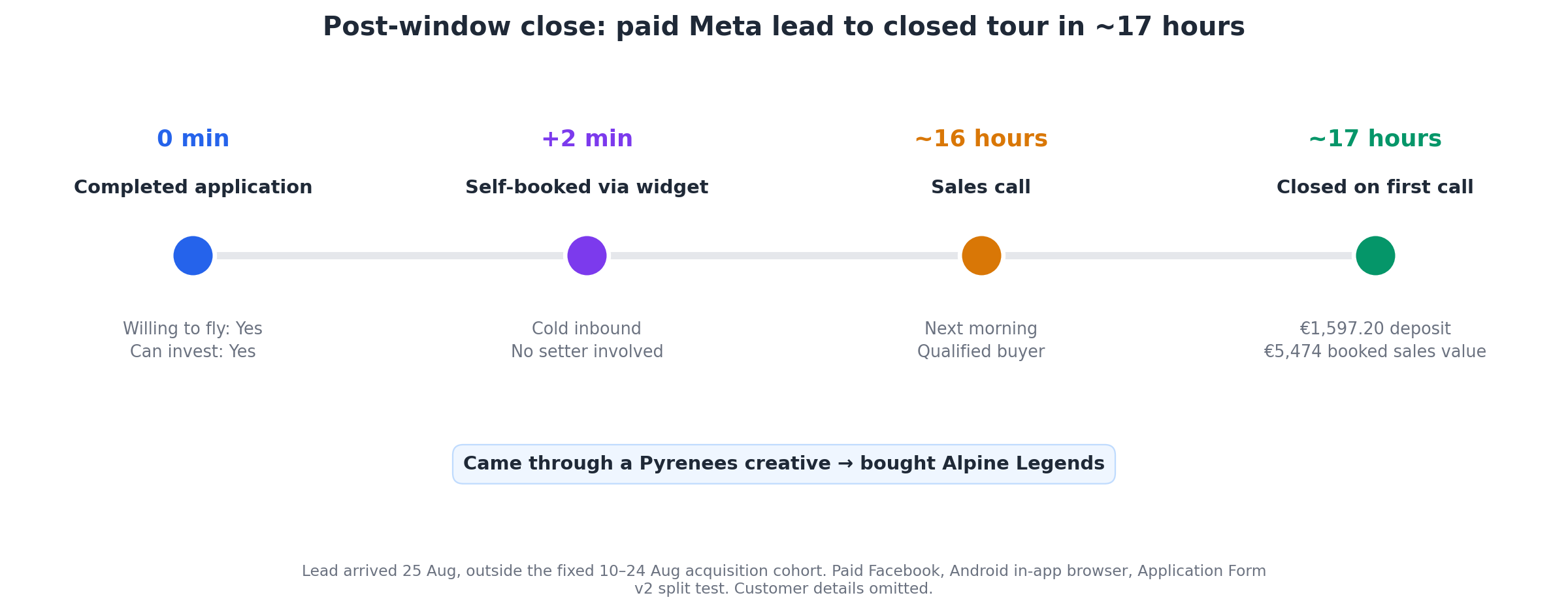
Completed application → self-booked in two minutes → first-call close roughly 17 hours later.
The lead came through a Pyrenees creative and bought Alpine Legends. That is a useful signal of category-level intent: the ad attracted somebody interested in the broader premium expedition offer, not only one exact itinerary.
The second timeline was faster:
- Applied: Aug 26 at 1:47 PM EDT through a paid-Instagram native lead form
- Device: Android in-app browser
- Targeting: broad, no interests
- Booked: in under one minute through the widget, with no setter
- Sales call: began 13 minutes after the application
- Outcome: closed on the first call, roughly 1 hour 35 minutes after the lead arrived
- Commercial result: €1,724 deposit and €5,748 in booked sales value
These are still individual deals. We will not turn two great sales alerts into a universal conversion-rate claim. What makes them meaningful is that they sit inside a larger pattern—324 applicants passing both gates, 113 booked-call contacts, and five verified post-fix-acquired closes.
What Actually Improved for Sales
The strongest sales improvement was not a promise that every lead would close quickly. It was a cleaner progression:
1. Partial records stopped pretending to be applications
From Aug 10–26, GHL contained 559 funnel records. Only 395 had the application fields required to count as completed, and 390 of those were attributable to paid Meta.
The other 164 records stayed outside the completed-application denominator. That protects both the ad report and the sales report from inflating demand with unfinished forms.
2. Qualification existed before the calendar
Among the 390 paid-Meta completed applications, 324 passed both commercial gates before a salesperson took the call.
That does not guarantee the applicant will buy. It does mean sales is not learning basic fit for the first time after the appointment starts.
3. The booking rate survived scale
The first four days after the repair reached a 41% booking rate. That early spike normalized as volume expanded.
The complete Aug 10–24 cohort now shows 102 booked-call contacts from 343 paid-Meta completed applications: 29.7%. That is close to REVV's old 28% baseline while processing materially more completed applications.
Broad and Travel performed better than the blend, at roughly 36% tagged-booking rates.
4. Sales velocity became visible
The five post-fix closes took approximately:
- 1 hour 35 minutes
- 7 hours
- 17 hours
- 4 days
- 13 days
There was no clean pre-fix close-time baseline, so we cannot claim a measured percentage improvement in sales velocity. We can say that three qualified paid leads closed inside 24 hours and all five observed post-fix leads closed within 13 days.
Did the Pixel Fix Cause Better Leads?
Not by itself.
A pixel does not create purchasing power, make somebody willing to fly, run a sales call, or improve the tour offer. REVV's team, positioning, creatives, qualification questions, calendar flow, and sales execution all matter.
The defensible claim is narrower:
- Meta had been optimizing from a polluted signal that included page views as applications.
- The repair restored a real completed application as the conversion signal.
- Budget moved away from the failing guessed persona and toward broader and creative-led acquisition.
- Downstream GHL evidence then showed high qualification-gate pass rates, sustained booked-call creation, and real deposits.
This is an observed before-and-after operating result, not a controlled experiment. The evidence supports “the cleaner acquisition system produced commercially useful leads,” not “one tracking change caused every sale.”
How We Counted
The article uses different systems for different facts:
- Contact and qualification data: GoHighLevel contact records, read through the connected location on 26 August.
- Complete follow-up cohort: contacts created Aug 10–24 in the account timezone, Europe/Madrid.
- Post-window pulse: Aug 25–26; Aug 26 was partial.
- Completed application: at least one of the application qualification fields was non-empty; native lead forms carried the same qualification fields.
- Paid Meta: Meta/Facebook attribution in the contact's source data, captured ad/ad-set identifiers, or paid-social UTM context.
- Booked-call contact: the durable
appointment_scheduledtag or at least one GHL appointment record. This found six booked contacts that had an appointment record but no tag across the combined snapshot. - Close: deduplicated internal sales alerts reporting a deposit. GHL pipeline stage was not used because paid customers were still present outside Closed-Won.
No customer names, emails, phone numbers, contact links, or API credentials are included.
One current-state note: the Aug 10–24 cohort had 98 booked-call contacts in the prior handoff. When re-read on Aug 26, the paid-Meta cohort had matured to 102. That is why cohort outcomes should be timestamped rather than silently overwritten.
Two sales arrived after the quality pull. The €1,500 Pyrenees deposit is counted as collected cash but remains outside acquisition-cohort reporting because its source, lead-created date, and total sale value were absent from the alert. The paid-Instagram native-form sale is counted as a fifth verified post-fix close because its Aug 26 acquisition trail is complete; it updates the sales ledger, but it does not retroactively change the frozen 390-application quality snapshot.
See the Attribution Loop Live
The point of first-party tracking is to keep the acquisition context attached long enough to evaluate what happened after the click.
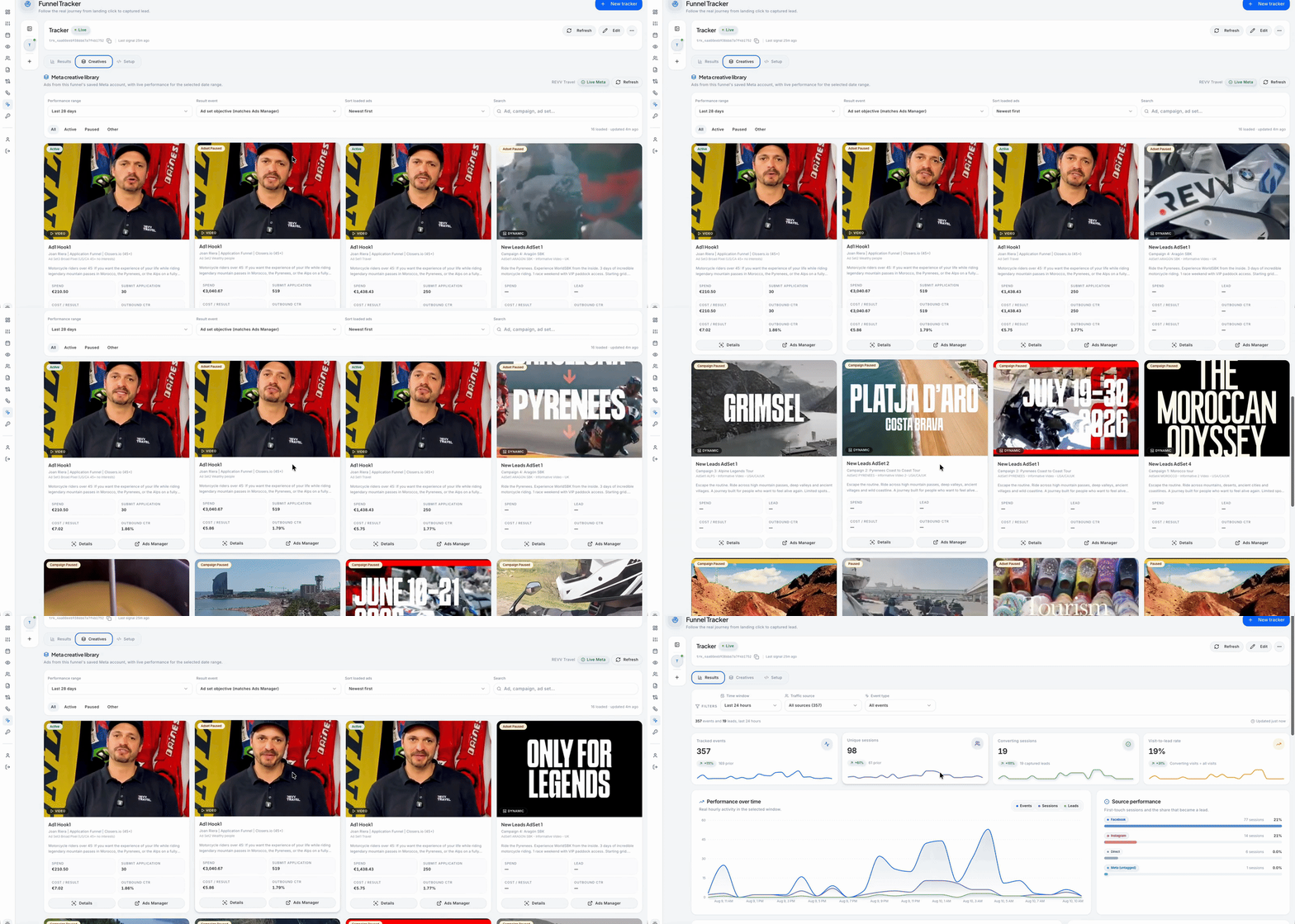
Creatives → Results: inspect the ad context, first-party journey, and captured outcomes in one workspace.
Funnel Tracker keeps first-party visits, UTMs, click IDs, captured leads, and live Meta creative context together. See Funnel Tracker: first-party attribution from ad click to lead.
For the other two layers:
- Pixel Wiring Studio sends one clean server-side SmartForm event for the real action.
- Smart Routing qualifies and routes submissions before they consume the wrong sales path.
Scope matters: Funnel Tracker is first-party journey tracking and lead matching, not call tracking, a revenue model, or a deal ledger. The deposits and booked sales values above came from REVV's own deduplicated sales reporting.
The Practical Test
If your ads dashboard says lead quality improved, verify it with four columns:
- Completed application
- Passed qualification gates
- Booked call
- Deposit collected
Break those columns down by campaign, ad set, creative, and form. The source with the cheapest first column is not necessarily the source sales wants more of.
Open Funnel Tracker, compare your live Meta creatives against captured lead journeys, and bring the same CRM cohort into the review. If the ad platform's success disappears before the calendar, the campaign is generating events—not qualified demand.
Updated on: 01/09/2026
Thank you!