
Case Study: Meta CPL Doubled Overnight — the Pixel Was Double-Counting. Here's the 4-Day Fix
The Short Version
REVV Travel — a Barcelona-based motorcycle tour and rental company — came to us with a Meta Ads account that had gone sideways: cost per application doubled in a week, one day delivered nothing at all, and the sales team was dialing leads that never booked. The budget hadn't changed. The funnel hadn't changed. The team suspected their new server-side tracking (CAPI) had broken the account.
Four days later REVV was producing more applications per day at a fraction of the worst-day cost — and, more importantly, a record share of those applications turned into booked sales calls. The fix wasn't more budget or a new funnel. It was tracking hygiene plus letting the pixel, not a hand-built audience, decide who sees the ads.
Metric | Before (worst day, Aug 5) | After (Aug 10) |
|---|---|---|
Meta cost per application | €14.07 | €3.90 |
Real cost per application (CRM-verified) | €25.33 | €4.74 |
Applications that become booked calls | 28% baseline, 8% on the dying audience | 41% sustained — 60% this week |
Cost per booked call | €110 on the old targeting | €17.50 |
Daily application flow | 12.4/day in the decline week | 16/day on slightly less spend |
Every number below comes from two sources checked against each other: the Meta Ads API and REVV's CRM. That cross-check is the method.
The Symptoms
Metric (week over week) | Jul 23–29 | Jul 30–Aug 5 |
|---|---|---|
Ad spend | €1,273 | €1,013 (−20%) |
Meta-attributed applications | ~350 | ~139 (−60%) |
Cost per application | €3.64 | €7.29 (+100%) |
Spend went down 20% and cost per lead still doubled. That combination is a signal worth memorizing: the account wasn't overspending — it was converting less, and Meta's delivery had turned unstable (an under-delivery day, then a full blackout day, then an overspend day at €14 per application).
Day 1: Trust Your CRM, Not Your Pixel
Ads Manager, the pixel, and the CRM each tell you a number of "conversions." Only the CRM counts real people. So the first move was not touching the ads at all — it was lining up all three sources for the same date windows:
Window | Real applications (CRM) | Pixel SubmitApplication events | Pixel ÷ CRM |
|---|---|---|---|
Before CAPI (Jul 15–21) | 164 | 133 | 0.8× — normal browser loss |
First CAPI week (Jul 22–28) | 196 | 443 | 2.3× — double counting begins |
Decline week (Jul 30–Aug 5) | 87 | 193 | 2.2× — Meta optimizing on noise |
The pixel was reporting more than twice as many applications as actually existed. Meta's algorithm had spent two weeks optimizing toward phantom conversions — and when an algorithm learns from noise, delivery gets erratic and lead quality slides exactly the way this account experienced.
The actual bug
Two events, no deduplication:
- A browser
SubmitApplicationevent placed in the header of the booking page — so it fired on every page view, not on real submissions. - A server-side (CAPI)
SubmitApplicationevent fired on the real form submission.
No shared event_id between them, so Meta counted both. Someone who applied and then visited the booking page counted twice; someone who just wandered onto the booking page counted once without ever applying.
The fix is boring and surgical — which is the point:
- Remove the browser event from the page header. A conversion event should never fire on a page view.
- Keep one source of truth: the server-side event on the real submission.
- If you ever run browser + server together, send the same
event_nameand the sameevent_idon both so Meta deduplicates them.
"Did CAPI cause this?"
REVV's first theory was that turning on CAPI broke the account. The same windows above disprove it: the week CAPI went live, cost per application improved from €8.34 to €3.65. CAPI wasn't the problem — the undeduplicated browser event next to it was. Killing CAPI would have removed the account's best signal source; the answer was dedupe, not retreat.
Day 2: Fire the Niche Audience, Hire the Pixel
With tracking headed toward clean, the second finding got addressed: ~70% of budget was flowing into a hand-built "wealthy" interest stack — high-net-worth interests, top-income ZIP codes, business-class travelers. It looked smart. The data said otherwise:
Hand-picked niche audience | Broad + pixel (replacement) | |
|---|---|---|
Targeting built from | A persona someone guessed | Only geo + age; the pixel's conversion history picks the people |
Cost per 1,000 impressions | €12.08 | €14.65 |
Cost per application | €7.60 | €7.24 |
Applications that book a call | 28% lifetime, 8% at the end | 41% while still in learning |
Cost per booked call | €27.40 lifetime, €110 at the end | €17.50 |
Read that middle row carefully: the niche audience's impressions and raw leads didn't cost more. The waste was invisible until you followed leads into the CRM — the niche audience produced form-fillers, the pixel-driven broad audience produces people who book calls. Per appointment on the calendar, the niche stack cost 57% more.
That's the quiet tax of interest-stack targeting: you pay Meta the same media prices to reach a persona you guessed, when the pixel — fed clean conversion data — can find actual converters in the broad pool.
So we:
- Paused the niche ad set entirely.
- Launched a broad twin: same geo, same age range, same creative — zero interest targeting, optimized purely on the (now-clean) application event.
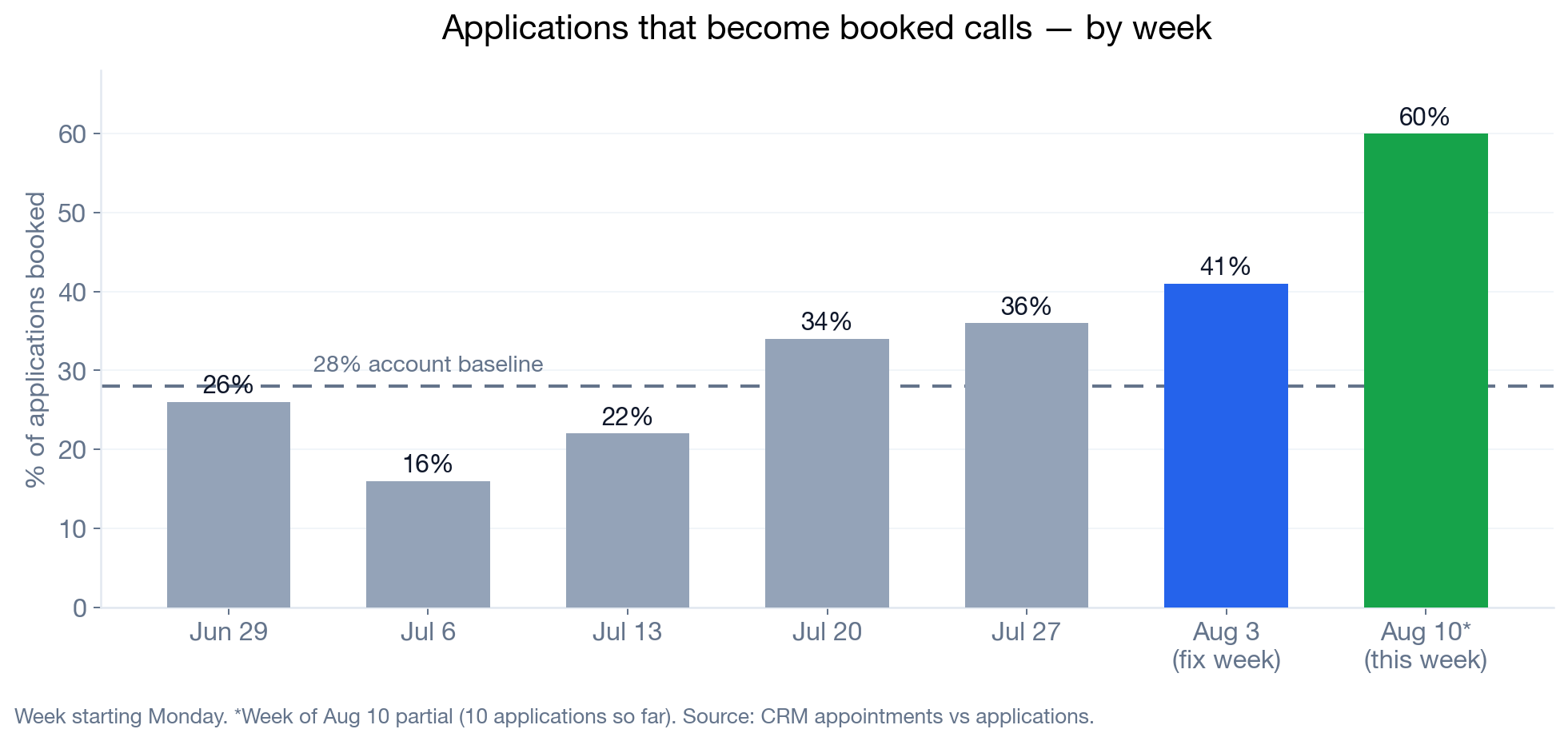
Booking rate by week. The account's historical ceiling was ~36%. The fix week set the all-time high at 41%, and the current week is tracking at 60%.
Day 3: Cap the Cost
With targeting and tracking fixed, the last leak was bid strategy: the campaign ran on Lowest Cost with no guardrail, which is how you get a €14/application day without noticing. We set a €6 cost-per-result cap at the campaign level. Delivery slows when Meta can't hit the number — that's the feature, not the bug.
The Results
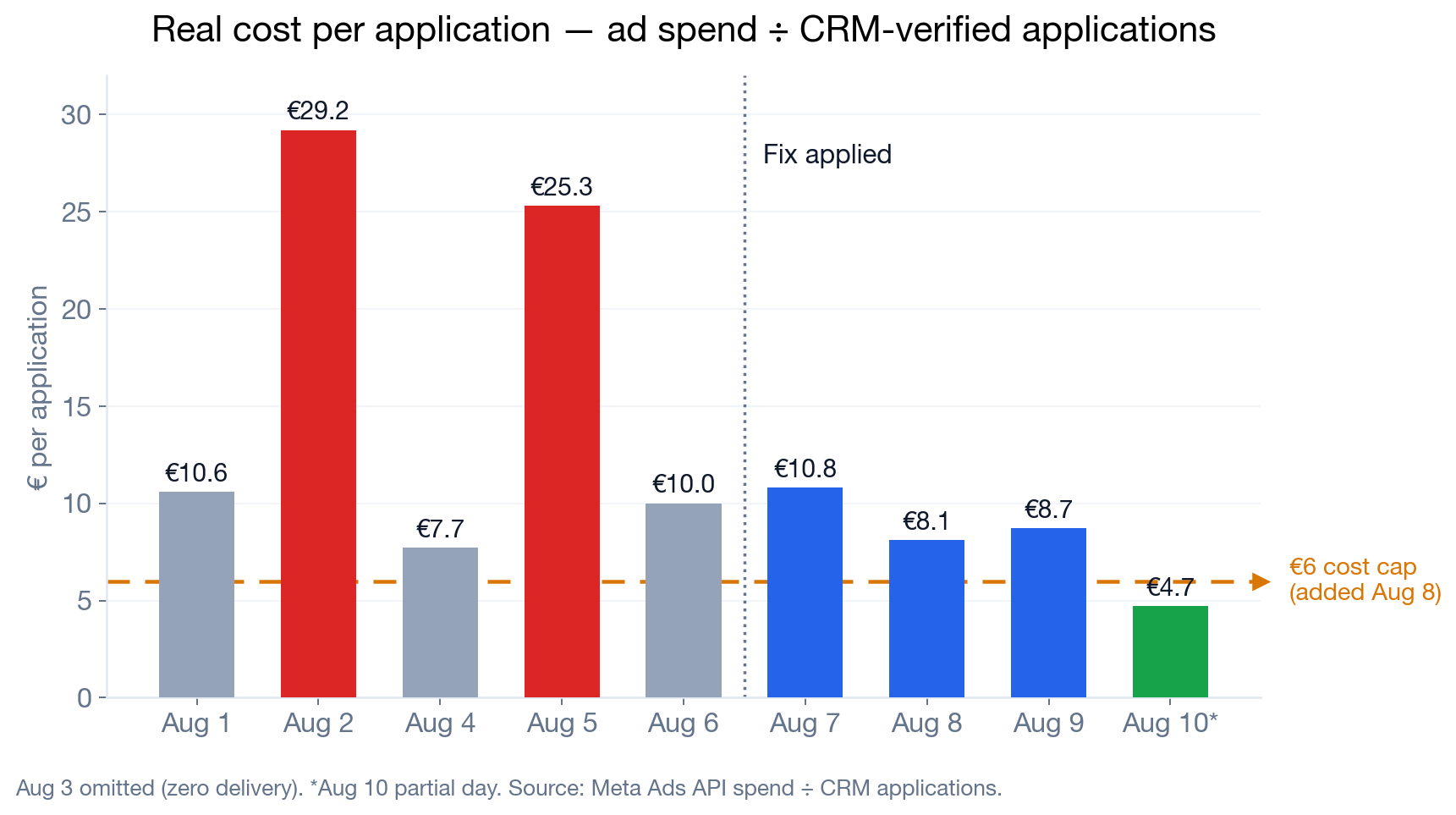
Real cost per application — ad spend divided by CRM-verified applications, not Meta's inflated count. Red days were the spiral; the cap and the new ad set brought it under €5.
Four days after the fix, verified against the CRM:
Ad set (since the fix) | Spend | Apps | Booked | Book rate | € / app | € / booked call |
|---|---|---|---|---|---|---|
Broad + pixel (new) | €210 | 29 | 12 | 41% | €7.24 | €17.49 |
Travel interest (kept) | €234 | 22 | 11 | 50% | €10.63 | €21.27 |
Niche "wealthy" (paused) | €110 | 12 | 1 | 8% | €9.20 | €110.34 |
And the part REVV felt on the calendar, in their own words:
"The account never hit a 50% booking rate before — the new ad set is doing it while still in learning. Bookings are coming from the new audience, which means the people we're reaching now are far more qualified."
Is Your Pixel Double-Counting? Run These Five Checks
- Count pixel events vs CRM leads for the same week. If Meta's event count is more than ~1.1× your CRM, something is firing that shouldn't. This is the single highest-value check in this article.
- Find every place the conversion event fires. View the page source and your tag manager. A conversion event in a header, or on a thank-you/booking page that people can revisit, fires on page views — not conversions.
- Open Meta Events Manager → your event → Event Deduplication. Browser + server both sending without a shared
event_idshows up right there. - Look at the timeline around your CAPI launch. A "miracle week" of cheap leads right after adding server events, followed by a cost blowup, is the classic double-counting signature — the algorithm feasted on inflated conversions, then reality caught up.
- Judge ad sets on cost per booked call, not cost per lead. Pull spend per ad set and divide by CRM appointments, not form fills. This is the number your business actually pays.
If check #1 fails, fix tracking before touching budgets or audiences — every optimization decision made on inflated data is a guess.
How SimpleCheck Bakes This In
This rescue was hands-on work by our team. The reason it took four days instead of four weeks is that the same pixel-vs-reality checks live in the product as a daily dashboard — not a one-off spreadsheet.
Funnel Tracker is that audit: first-party capture of every visit, UTMs and click IDs, live Meta spend next to real leads, and each conversion matched back to its session — so "what Meta claims" and "what actually happened" sit side by side. See Funnel Tracker: first-party attribution from ad click to lead.
Setup → Results → Creatives — live Funnel Tracker walkthrough at 1.5×.
For the delivery side of this story — one clean server-side event per real action, with event identity handled — see Pixel Wiring Studio. And the lead-quality half — optimizing on qualified leads instead of raw form fills — is what Smart Routing does on the form you already run. More on the ROAS mechanics in Ad Performance: how SmartForm improves ROAS.
Scope honesty, because trust is the product: Funnel Tracker is first-party journey tracking and lead matching, not call tracking or revenue modeling. Pixel Wiring covers Meta CAPI for SmartForm funnel events — it is not a multi-channel attribution suite.
What Happened Next
Four days was enough to prove the rescue. It was not enough to prove the business result.
- The Simple Version is the one-page story you can send to anyone.
- The 15-day follow-up is the scaled result: 343 verified applications, 98 booked calls, and the closed-tour ledger.
- The sales and lead-quality review is what reached the sales team after the fix.
Next Step
If your Meta numbers feel expensive and your calendar feels empty, run check #1 today: one week of pixel events next to one week of CRM leads. If the ratio is off, you know where your budget went.
Then open Funnel Tracker in the portal — or message support from the portal chat with your Ads Manager count and CRM count for the same week, and we'll help you read the gap.
Updated on: 29/08/2026
Thank you!